
Thank you for Subscribing to Chemical Industry Review Weekly Brief
Chemical Industry Review: Specials Magazine
How can PFAS contamination be permanently destroyed without disrupting industries that depend on forever chemicals? You wake up in the morning and reach for your phone. You drive to work. You board a plane. You pick up a prescription or watch someone you love recover because a medical device did what it was designed to do. Each of these moments feels unrelated. But per- and polyfluoroalkyl substances (PFAS) thread through each one. PFAS have built modern life, behind the panels and under the wiring. Five hundred miles of PFAS-coated wire keep a commercial aircraft from catching fire. Heart stents and IV lines depend on them. Semiconductor fabs rely on them to etch the chips that run everything from a phone to a power grid. Pharmaceutical manufacturing uses them to deliver medications that work as intended. Strip PFAS from everyday life and halt the availability of products essential to modern life. That is the chemistry at the center of this story. PFAS are in the water. They persist, accumulate and earn the nickname ‘forever chemicals’ because once they enter the environment, they stay. For decades, public conversation has treated this as a binary. Ban PFAS or accept the contamination. Two unsatisfying answers to a question that deserves a better one. Claros Technologies is building a better answer, the third way. ClarosTechUV™ destroys long-, short- and ultra-short-chain PFAS compounds in aqueous waste streams at rates of hundreds of gallons per minute, with 99.99 percent effectiveness using a proprietary reactor system. What this means is that PFAS chemistries are broken apart and mineralized down to their elemental components, primarily fluoride ions, rather than captured and moved elsewhere. Permanent destruction is now possible. “The story is not simply about a new technology. It is about an inflection point where the PFAS challenge begins to shift from a problem that must be managed to one that can realistically be solved,” says John Brockgreitens, Ph.D., VP of Product Development and Co-founder of Claros Technologies. Industries that depend on PFAS no longer have to choose between using them and protecting the environment around their facilities. Regulators no longer have to weigh economic disruption against environmental responsibility.
Top Green Chemistry Service 2026
What approach does Biofine use to convert cellulosic waste into fuels and chemicals? Biofine Technology has spent 25 years refining a hydrolysis reactor designed to convert cellulosic waste into fuels and chemicals at commercial scale. The system is structured around identified end markets and controlled expansion, with scale-up risk deliberately confined to the hydrolysis reactor. How does the proprietary hydrolysis reactor separate feedstock into valuable output streams? At the core of the process is a proprietary hydrolysis reactor that separates lignocellulosic feedstock into discrete valuable streams based on high yield primary outputs of levulinic acid, formic acid, furfural and biochar. Innovation is intentionally concentrated within this reactor, while downstream separation and purification rely on established commercially available equipment. This deliberate configuration limits technical uncertainty during expansion. With 25 years of development and 30 million dollars invested, the reactor has logged thousands of operating hours across forest residues, waste paper and agricultural wastes. Profitability potential was indicated at the demonstration stage, establishing commercial discipline before scale. U.S. process patents awarded in 2012, 2014, 2016 and 2025 reinforce the technical defensibility of the platform. Dr. Stephen Fitzpatrick received the Presidential Green Chemistry Award in 1999, underscoring the scientific foundation behind the technology. “Our uniqueness lies in the capacity to valorise every fraction of the feedstock to ensure no material goes to waste,” says Dr. Stephen Fitzpatrick, President..

Inorganic Color Pigment Manufacturer

The Shepherd Color Company has spent almost a century shaping the future of high-performance complex inorganic color pigments. As a fifth-generation family-run business, Shepherd Color creates pigments tailored to the precise needs of industries such as paints and coatings, plastics and ceramics. Its focus on performance-driven solutions has propelled it to the forefront of the global pigments market, distinguishing the company as an indispensable partner for businesses seeking high-performance, durable and long-lasting colorants. Today, Shepherd Color thrives under the leadership of Tom Shepherd and his children, who continue to honor the company’s core values—demonstrating exemplary character, striving for excellence, and working for long term impact. Their unwavering dedication to brightening lives is the guiding principle that drives every facet of its operations, from exceptional product development to world-class customer satisfaction. The company’s strong emphasis on customer service is built on decades of trusted relationships. Many of these partnerships have lasted over 50 years, enabling mutual growth as the company and its customers thrive together. This enduring trust and collaboration have strengthened Shepherd Color’s standing as a leading provider of high-performance inorganic color pigments, trusted by clients who value reliability and longevity. Color Solutions for Extreme Durability The company develops these pigment solutions for highly demanding applications, particularly in the architectural exterior coatings market. Unlike traditional paints, which prioritize price over durability, Shepherd Color’s innovative pigments are designed to enhance the longevity of exterior finishes like stucco, siding, and metal roofing, offering robust protection against weathering and fading. For example, in the metal building industry, commonly known as the coil coating industry, the requirements for coatings’ film thickness was very thin, but existing pigments were too large. Shepherd Color developed pigments tailored specifically for these applications by reengineering its particle size control and manufacturing processes, and becoming the standard for use in this application. “Not only do we solve client issues, but there are instances where we assist them with challenges unrelated to our products, ensuring their success as a part of our commitment to exceptional service,” says Chris Manning, President.
Top Industrial Chemical Products & Lubricant Additives Manufacturer 2026
Industrial operators across transportation, manufacturing and heavy equipment environments face increasing pressure to improve fuel efficiency, manage maintenance costs and meet evolving emissions requirements. Variability in fuel quality, combined with tighter equipment tolerances, creates conditions where small inefficiencies can translate into significant operational impact. Fuel Ox addresses this challenge by focusing on how additives perform within real operating environments rather than optimizing for isolated specifications. Its formulation philosophy is built around system-level performance, where fuel, equipment and operating conditions are evaluated together. “Our formulations are engineered to deliver measurable benefits in real operating conditions, not just nominal spec compliance,” says Rand Taylor, CEO and co-founder. Designing Additives around Real-World Conditions A recurring issue for industrial operators is the inconsistency of modern fuel streams. The use of ultra-low sulfur diesel, biodiesel blends and renewable fuels introduces challenges such as reduced lubricity, oxidation instability and increased water retention. Fuel Ox approaches this by designing formulations that stabilize fuel, improve combustion efficiency and protect system components. Rather than treating these issues independently, its chemistry is structured to address fuel behavior across the entire system. This approach supports more complete combustion, reduced deposit formation and improved fuel economy. By focusing on how fuel performs over time in actual operating conditions, the company helps operators extract more usable energy while protecting critical components such as injectors and storage infrastructure. Integrating Development, Testing and Manufacturing Delivering consistent performance requires more than formulation design. Fuel Ox integrates research, testing and manufacturing into a continuous development cycle that ensures repeatable results at scale. The process begins with evaluating real-world fuel trends, equipment requirements and environmental conditions. From there, multi-functional additive packages are developed to balance stability, lubricity, corrosion protection and combustion efficiency.

Top Adhesive Tapes Manufacturer 2026

Manufacturers working across automotive, construction and specialty applications face a recurring challenge of achieving consistent surface protection, clean finishes and efficient workflows. Adhesive tapes, often treated as commodity products, can introduce variability that affects quality and productivity. Cellux addresses this by approaching adhesive tapes as technical components rather than generic supplies. Its model focuses on aligning adhesive chemistry and backing materials with specific application demands. “We do not treat tape as a generic commodity. We see it as a technical component that directly affects process quality, surface protection, labor efficiency and final finish,” says Harry Barbosa, country manager. Matching Materials to Application Demands A key issue for manufacturers is balancing performance, durability and cost efficiency. Challenges such as paint bleed, poor adhesion, tape lifting on curves and residue during removal, can lead to rework and increased labor. Cellux addresses this by developing application-specific products tailored to distinct use cases. Its portfolio includes professional-grade tapes for high-volume use and premium solutions designed for precision applications requiring clean lines and extended performance. Material selection plays a central role in this approach. The company has expanded beyond traditional masking papers to incorporate semi-crepe and Washi technologies. Semi-crepe materials provide strength and flexibility for demanding environments, while Washi supports precision and surface protection in sensitive applications. This strategy enables users to select solutions based on performance requirements rather than relying on a single product across all tasks.
CXO INSIGHTS

Innovation and Specialty Chemistry: Which Technologies are on the Horizon
Ottavio Rombola, Director of Research Development, Sika USA
The Impact of Chemical Bans on The Manufacture of Food-Contact Plastics
Mitzi Ng Clark, Partner, Keller and Heckman LLP

Impact of Digital Transformation on Supply Chain
Johnny Ivanyi, Global Head of Logistics CoE, Bayer Crop Science

From Molecule to Medicine, the Science Behind Formulation
Jack Xiang, Formulation Scientist, Abbvie [NYSE: ABBV]

Mastering Market Signals in the Chemicals Industry
Joel Morales, Vice President, Polyolefins Americas, OPIS

Nurturing Tomorrows Food Through Sustainable Leadership
Christina O'Keefe, Regional Head of Sustainability, Kerry


IN FOCUS

Charting a Sustainable Course: Green Chemistry in the Modern Chemical Industry
Green chemistry transforms chemical manufacturing by reducing environmental impact, improving efficiency, enhancing safety, and strengthening long-term industrial competitiveness globally.
Effective Approaches to Mitigating PFAS Environmental Impact
Sustainable PFAS destruction solutions through innovative technologies are crucial for managing environmental contamination and ensuring regulatory compliance.
EDITORIAL
The Chemistry of Sustainable Growth
The chemical industry is entering a defining phase where sustainability, efficiency and resilience are becoming central to long-term growth. Manufacturers are meeting rising environmental expectations and evolving industrial demands with scalable technologies that enhance performance while reducing impact. Chemical Industry Review spotlights organizations and leaders advancing the field through continuous processing, green chemistry and industrial innovation.
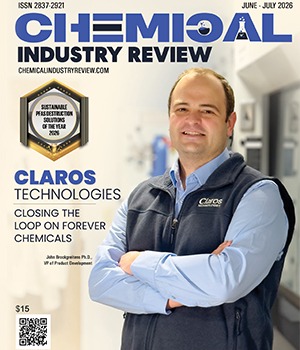
The cover story features Claros Technologies, recognized as Sustainable PFAS Destruction Solutions of the Year 2026, for redefining how industry addresses forever chemicals through permanent PFAS destruction at industrial scale. Through its ClarosTechUV™ platform, the company is enabling sustainable treatment solutions that support regulatory compliance, operational efficiency and long-term environmental responsibility.
Biofine Technology, awarded Top Green Chemistry Service 2026, has developed a proprietary hydrolysis reactor that transforms cellulosic waste into renewable fuels, platform chemicals and carbon-sequestration products. Its carbon-negative design and broad commercial applications highlight the growing viability of green chemistry at scale.
Fuel Ox, recognized as Top Industrial Chemical Products & Lubricant Additives Manufacturer 2026, delivers system-level additive formulations that boost combustion efficiency, stabilize fuels and protect equipment in demanding environments.
Industry perspectives further reinforce the edition’s focus. Christopher Stebbins, Head of SHES - Specialty Mining Chemicals at Orica, examines leadership-driven safety cultures in high risk industries, while Kelvin Roth, Vice President of EHSQ at CF Industries, explores how aligning culture, strategy and innovation builds resilient EHS systems that sustain industrial growth.
Together, these insights reflect an industry direction where continuous manufacturing, green chemistry and intelligent performance are redefining competitive advantage. As chemical manufacturers balance sustainability, efficiency and reliability, innovation is shaping industrial transformation. Readers are invited to explore this edition and engage with leaders advancing the global chemical industry.
